I was born in September of 1945 in the Adelaide Hills of South Australia. When I started writing this page I was over 80 years old. The changes that have happened to human civilisation and our shared planet over the period of my lifetime have been many, important, impactful and mind-boggling.
The advances in science, the damage to our environment, the technological developments, may have been as great as in the whole previous millennium.
This page aims to discuss those changes and any relationship they may have had on my thinking, actions and life. A related page on this site is Milestones in the development of human society which attempts to cover, not only my lifetime, but the whole historical period. The events that I've felt to be most important may not come so high on other people's lists. The judgements are subjective and will vary from person to person. The entries are in some degree in chronological order, but full chronological order conflicted with putting like with like, so there's a compromise. I have strongly expressed my opinions on the matters discussed on this page in places. Golden AgeI have been fortunate in living through what I believe could with justification be called a Golden Age, at least for those who have had the good fortune to live in the 'Western World'.Living standards have been high all my life. There have been greater advances in science, knowledge and health than in any other age. People in the Western World have had more freedom than humans have had in most of the last thousand years: freedom of movement, freedom of thought and speech, freedom of religion (or the freedom to put aside religion). We have had far more choice and variety in what to read, listen to or watch than in any other age, we have a relatively classless society and access to a good education. Tolerance of sexual differences and equality between the sexes has increased greatly in my lifetime.
There have been wars, but they have not been fought in Western Europe, North America, Australia or New Zealand. I have lived through a long period of peace that has been rare in history. There have been epidemics and famines, but they have mostly not directly impacted people in the Western World. I, and most people in the West, have enjoyed a healthy and abundant natural environment. It is now being degraded (and the people of the West have been most at fault in causing this) but during my lifetime it has been available to be enjoyed and has been functional in keeping the biosphere in good health. There are many poor people in the West, but few have had to live in abject poverty in my lifetime. Will the next 80 years be so rosy? I don't think so.
Contact: David K. Clarke – © |
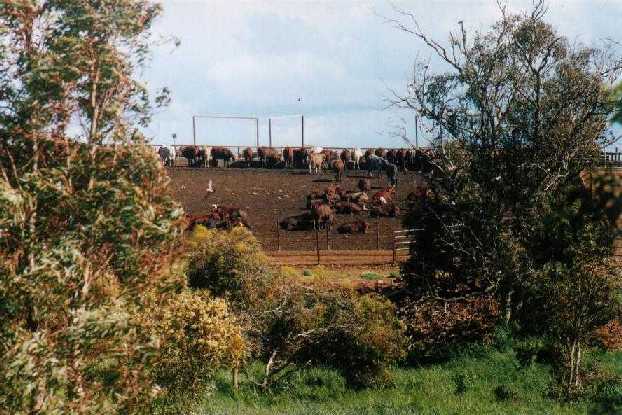
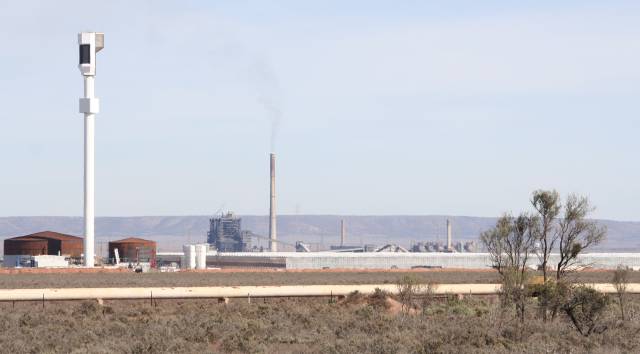
Climate changeClimate change and the related problems are by far the greatest threats facing humanity and all life on the Earth today. This has become more and more obvious during most of my long life. I have placed this piece high on this page because it deserves to be at the top of all our minds.The burning of fossil fuels is widely recognised as the main cause of not only climate change but also ocean acidification, ocean warming and sea level rise. The air pollution from the burning of fossil fuels kills millions of people world-wide each year. Consequently I have advocated action on reducing the mining and burning of fossil fuels and changing to renewable energy with urgency from at least the 1980s to the present. What has happened instead is action that is far too slow, and Australian governments in particular are still propping up the fossil fuel industries instead of working toward closing them down. Wikipedia ranked Australia 13th of several hundred countries/territories/regions/groups in greenhouse gas emissions per capita in 2023. Australians were responsible for 3.3 times the average global citizen's emissions. The Chinese, who get a lot of criticism from people ignorant on the subject, comes about 34th with 1.7 time the average global citizen's emissions. |
|
|
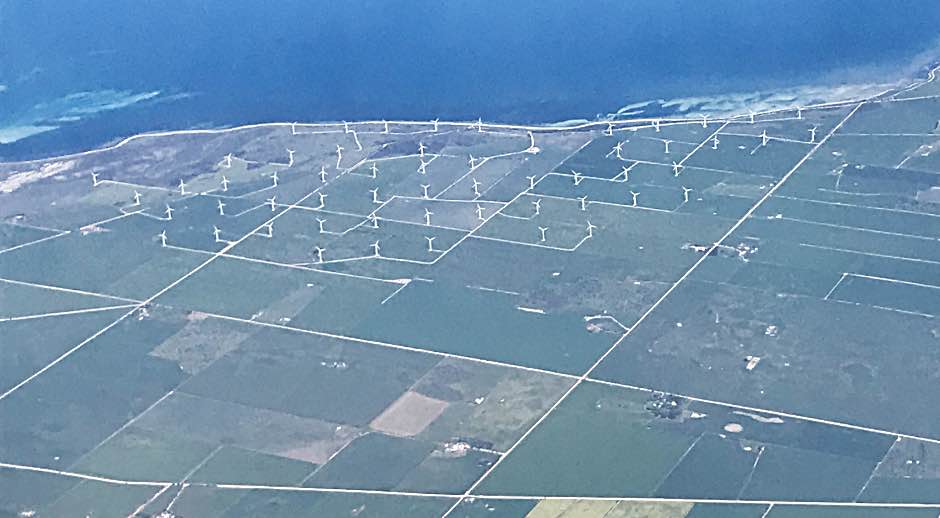
In the critical years of wind power development, between about 2005 and 2020, South Australia, the state in which I've spent the great majority of my life, lead the nation in wind farm construction. My region of SA, the Mid North, has been a leader in renewable energy, a matter of which I am enormously proud. |
Important developments before I was bornI will make no attempt to produce anything like a history of this enormous period, I've written something of it in Milestones in the development of human society, but I will mention two advances in science of the twentieth century that were paradigm changing:
Some of my early recollectionsI lived my first 23 years in a small town, Charleston, in the Adelaide Hills (an ill-defined section of the Mount Lofty Ranges). My father, Kenneth S. Clarke, ran a successful garage and farm service business and I think we were financially better off than average. |

|
The people in the foreground, from left to right standing are my son Ken and daughter Julia, squatting are granddaughters Adelaide (Ken's daughter) and Anna (Julia's older daughter). |
|
The town electricity supply came to Charleston sometime in the late 1940s or early 50s. We had mains electricity as long as I can remember, so I'd guess the connection was in the earlier part of that period. We didn't get mains electricity onto our farm, about 5km east of Charleston, until about 1964. Before that a generator, powered by the same petrol powered engine that ran the milking machine twice a day, charged a small bank of batteries that then supplied 12 volt power for the farmhouse.
Some people at the time made do with ice-boxes, insulated boxes that would be kept cool by a large (10kg?) block of ice. I recall that we used to hire caravans for annual holidays, before buying our own, and that at least some of these had ice-boxes rather than refrigerators. Surprisingly, we didn't have a toaster. I recall that we made toast by kneeling on the floor and tilting up an electric radiator and placing a couple of slices of bread, side-by-side, on that. We had an AM (amplitude modulated) radio for as long as I can remember, but not television. My first sighting of television was on a bus holiday with my mother to Sydney, about 1957 when I would have been 12 years old. I was immediately hooked. TV didn't come to Adelaide until 1959. It was black and white, colour TV came 16 years later, in 1975. Fortunately our house must have been more or less in line of sight of the TV transmission towers on top of Mount Lofty, we didn't need the tall antennas that were required at places like Crystal Brook and Port Pirie. FM (frequency modulated) radio didn't come to South Australia until 1975.
"The passenger train connecting Adelaide to Charleston (via the Balhannah to Mount Pleasant line) historically ran twice a day in each direction during its operational lifetime.We much more often drove to Adelaide than used the train because the train was so slow (the times would have meant staying in Adelaide overnight too). There were two roads, we usually went via Balhannah, because the Lenswood road was windy and I would get car-sick. My brothers and I had books sent to us on the train (monthly?) from the Adelaide Lending Library. I recall that they were just left in the shed at the railway station (which was unstaffed). A butcher and baker with their vans would visit Charleston, I don't recall the frequency, and a draper would come less frequently. I suppose an ice-man came too, for those who had ice-boxes rather than refrigerators. People having German descent in SAWhen I was on school holidays I might go out with my mother to the butcher's van. He would give me a slice of fritz. Fritz, as a name for a type of sausage, seems to be confined to South Australia. The name apparently comes from a German butcher with that name; fritz was an abbreviation of 'Fritz's sausage'. There were many people of German descent in the Adelaide Hills. The earliest German immigration started in 1838, only two years after the colony was proclaimed; I've recorded something of this on another page on this site. One of my best childhood friends was of German descent. |
A dust storm rolls over Charleston; date unknown, probably early 1960s.
| |
|---|---|

|

|

|

|
The images were from 25mm colour slides. | |
Developments that happened in my lifetimeEarly major wars1945, an eventful yearThe Second World War ended just before I was born, with the surrender of Germany in May (1945/05/07) and of Japan in September (1945/09/02), just days before I was born.The first, and so far, the only nuclear weapons used in wartime, were those dropped on Hiroshima on 1945/08/06 and Nagasaki on 1945/08/09. The first man-made self-sustaining nuclear chain reaction had been achieved several years earlier, in Chicago in the USA, on 1942/12/02. NATOThe North Atlantic Treaty Alliance, was formed in 1949/04/04 when I was four years old. Russia exploded its first atomic bomb on 1949/08/29. The Cold War started about this time. From then to the present the potential of nuclear war has been a reality.Following the collapse of the Soviet Union in 1991/12/26 many former Warsaw Pact countries and Soviet states embraced democracy and joined the alliance, integrating into Europe. Following Russia's invasion of Ukraine Finland joined NATO in 2023 and Sweden (which had maintained a neutral stance for over two centuries since the Napoleonic Wars) joined in 2024 bringing the total number of allies to 32. There's some nice irony in this as one of Russia's excuses for invading Ukraine was a fear of Ukraine joining NATO. The invasion caused an enlargement of NATO. See also the European Union, on this page. 1950 - 1953, Korean WarI was five when the Korean War started and eight when it finished. It ended only with a truce, not an official ending; there was no winner, as in so many wars both sides lost in lives and property. Fortunately the truce has stood ever since.In my opinion this was probably the last war that my country, Australia (and the USA), were justifiably heavily involved in (Afghanistan is a questionable case). Had we not fought against North Korea the whole of the Korean Peninsula would probably be suffering under the tyrannical and cruel rule to which the North Korean people have been subjected ever since.
VaccinationPolio vaccination: 1955 and 1961Quoting Google's AI: "Dr. Jonas Salk’s inactivated (killed) polio vaccine (IPV) [was developed] in 1955, and Dr. Albert Sabin’s oral (live-attenuated) polio vaccine (OPV) in 1961."
The World Health Organisation has a page on the history of polio vaccination. Childhood diseases and vaccinationDiphtheria, measles, chicken pox, whooping cough and mumps have infected many millions of people in the past, and killed many millions, especially those in the parts of the world where there little resistance had been built up by long association. In the centuries since the European settlement of the Americas the most numerous deaths have been among the native Americans, Pacific Islanders, Australian Aboriginals and similar peoples. Over the millennia before that a great many Europeans would have suffered and died until some level of natural immunity, or at least tolerance, developed.At the time I wrote this page there was a diphtheria outbreak in central Australia that would not have happened had more of the people involved been vaccinated. The Conversation ran an article on Why diphtheria, whooping cough and measles have come back in Australia, written by Adrian Esterman on 2026/05/21.
To not vaccinate in this age is stupid, and to refuse to allow your children to be vaccinated is not only stupid, it is grossly irresponsible and criminal. Vietnam and the Vietnam WarAustralia became involved in the Vietnam War in mid 1962. The first Australian combat troops were sent over in 1965. Australia's involvement lasted until 1973.Young Australians were conscripted into the military to fight in Vietnam. I was of the 'right' age to be conscripted, but the selection was based on a lottery process and my number didn't come up. It was in the period when I was working on the family dairy farm. I've written about the Vietnam War on one of my travel pages. Australia fought with the Americans for the corrupt South Vietnamese government and the wealthy land-holders, and against the poor people and the subsistence farmers of Vietnam. We were fighting on the wrong side of that war. As mentioned under Cambodia; the Killing Fields Vietnamese forces ousted the murderous Pol Pot regime in 1978. This action must have saved a great many Cambodian lives yet the USA condemned Vietnam for its action and China mounted a 'punitive' invasion of Vietnam in 1979 to punish the Vietnamese for freeing the Cambodians from the Khmer Rouge. Ethical concerns rarely rate highly with national governments. |
Bai Dinh Buddhist temple, Ninh Binh, Vietnam
|
|---|

|
How many Buddhas are enough? There were thousands in this temple complex. This photo was taken on a visit to Vietnam in 2011 Click on the image (or touch it) to see full size |
Several visits to VietnamDenece and I visited Vietnam in 2004, 2006, 2008 and 2011. We noticed no animosity from the people for the actions of Australians and others during the war.We did notice a fear of the possibility of another invasion from China. Cambodia; the Killing Fields
Vietnamese forces invaded Cambodia in December 1978 and quickly, as I recall, toppled the bloody Khmer Rouge regime. I felt that this was greatly to the credit of the Vietnamese, and was shocked when the USA condemned the invasion. This was just one of a great many reasons for me having no respect for the USA. We, in the West, don't pay enough attention to what I call The Real USA.
China mounted a 'punitive' invasion of Vietnam from February 17 to March 16, 1979, in response to the Vietnamese freeing the Cambodian people from the murderous Khmer Rouge regime. I believe the invasion didn't go well for China, they got their 'noses bloodied')
|
Angkor Wat, Siam Reap, Cambodia, not long after sunrise
|
|---|

|
Denece (in the foreground here) and I visited Cambodia in 2011. On our first visit to Angkor Wat we stayed with the crowd and waited near the main entrance on the western side for the sunrise. On our second day we walked straight around to the eastern side, the side that would be illuminated by the newly risen sun. The photo above was taken from the northeast. |
China
Just by the way, I asked the Chinese AI app "What was The Great Leap Forward?" The reply I got was, "Sorry, that's beyond my current scope. Let's talk about something else." Then I asked "What were the Cambodian Killing Fields?" and got a realistic answer. It should be noted that China strongly supported North Korea in the Korean War and has supported it ever since. Thus China must take some responsibility for the miserable situation of the North Korean people ever since the war. China's 'punitive' invasion of VietnamChina mounted a 'punitive' invasion of Vietnam from February 17 to March 16, 1979, in response to the Vietnamese freeing the Cambodian people from the murderous Khmer Rouge regime. I believe the invasion didn't go well for China, they got their 'noses bloodied')
Tiananmen SquareIn 1989, when I was 44 years old, the Chinese 'People's Liberation Army' opened fire on peaceful protesters in Tiananmen Square killing hundreds, possibly thousands. Quoting Amnesty International:"In the aftermath, authorities carried out a nationwide campaign of repression. Tens of thousands of people were arrested, detained or imprisoned, and many faced harsh sentences. In the decades since, the Chinese government has strictly censored public discussion of the events, seeking to erase them from collective memory. Despite this, commemorations and calls for truth, justice and accountability continue around the world." Hong KongI will not go into detail here, Wikipedia has an article on the history of Hong Kong but I will write a little. The British handed Hong Kong over to China after their 99 year lease ended in 1997. At first the Chinese government said that Hong Kong and China would be 'one country under two systems' with greater freedoms for the Hong Kong people than in the remainder of China. Since then they have taken to oppressing the Hong Kong people as they have oppressed other Chinese citizens.Considering all of the above Chinese governments during my lifetime have consistently oppressed their people and care not at all for civil rights. European UnionThe birth of the European Union happened with the Maastricht Treaty in 1992 when I was 47 years old, but there had been actions toward European unity before that.The single currency to be used through the Union, the Euro (quite distinct from the euro that is a species of large marsupial and a type of wallaroo native to Australia) came from 1999 to 2002.
Britain (foolishly) left the EU in 2020 following a referendum in 2016. See also NATO, on this page. Invasion of IraqThe invasion was conducted by a United States-led coalition of mainly American, British, Australian, and Polish troops in 2003. George Bush the younger was the prime mover; Tony Blair (Prime Minister of the UK) and John Howard (PM of Australia) followed along like gullible idiots. The main justification for the invasion was that Saddam Husain, the President of Iraq, was a threat to the West because he was developing weapons of mass destruction; this turned out to be quite false. (Of course the USA has more weapons of mass destruction than any other nation on Earth.)PM Howard probably felt that he would somehow go down in history as being some sort of an heroic and visionary leader, in fact he should go down in history as perhaps Australia's most criminal leader. What worse crime can a leader commit than to involve his nation in an unjustified, unethical, illegal, and counter-productive war? Thousands of Australians marched against the preposed invasion, before it happened, myself included. Prime Minister John Howard ignored us, and the gutless Australia federal coalition politicians went along with him. One of the main responsibilities of politicians is to limit the excesses of their (and our) leaders, the Australian politicians failed badly in this. This is just one of the faults of party politics as it exists in Australia in recent years, and why electing more community independent representatives would solve this problem. Equal pay for womenIn 1969 the Australian Commonwealth Conciliation and Arbitration Commission ruled that women should receive equal pay for doing the same work as men. In 1972 the Commission expanded the ruling to "equal pay for work of equal value," meaning women's work was assessed on its own merits rather than its resemblance to male roles.
Afghanistan, invasion and occupationAustralia was involved in Afghanistan from 2001 to 2021. Over 39,000 Australian Defence Force (ADF) personnel were deployed. The mission evolved from initial counter-terrorism operations to provincial reconstruction and local force training.I believe that the American, Australian and other nations (including UK, Canada, Germany, France, Italy and the Netherlands) involvement gave the Afghan people, especially the women, more freedom while the forces were there, but when the international forces pulled out the Taliban took over and forced a sick theocratic dictatorship onto the Afghan people. Did our involvement in Afghanistan do any good in the long term? I don't know. I think the intentions were good. Did the good people in Afghanistan try hard enough toward obtaining good government and freedom from religious bigotry? I suspect many did, but apparently not enough. Animal rights and the humane treatment of animals
The recognition that animals should be treated humanely has probably advanced in my lifetime, but considering the enormous number of, especially, pigs and chickens that are raised in inhumane conditions and other unnecessarily cruel treatment of animals at the time of writing I'm not sure that animal's overall situation has improved.
I've written on the treatment of animals and their rights on another page on this site.
Pollution
It is far too big a subject for me to go into on this page, there is an article on Wikipedia on the History of environmental pollution. Use-once-and-throw-away items are one of the most widespread forms of solid environmental pollution that I've seen over the past several decades, as in the photo on the right. PlasticsThe rise in the use of plastics in my lifetime could probably be one of the defining features of the age. Many earth scientists believe that humanity has changed the world so much that the defining of a new geological age, the Anthropocene, is justified. Sediments laid down in this age will be largely recognisable by the amount of plastics in them.Most plastics are not biodegradable, they may degrade due to the impact of ultraviolet light and other forms of weathering, but while that might make them more brittle and result in many smaller pieces replacing fewer big pieces, it doesn't removed them from the environment.
I suspect that we have a long way to go before we can understand the impact of plastics on lifeforms, and perhaps even further before we do anything to limit those impacts.
ReligionIs religion better called a superstition or a delusion? It is both.Over my lifetime Australia’s religious landscape has transformed fundamentally. While Christianity was historically dominant early in my life, national census data reveals a dramatic shift toward secularism and religious diversity. When I was a young child nearly 88% of the population identified as Christian. By 2016, this figure had dropped to 52%, and in the 2021 Census, it fell further to 43.9%. Secularism has grown exponentially. In 1971, only 6.7% of Australians reported having "No Religion". By 2016, this jumped to 30%, and in 2021 it reached 38.9%.
Perhaps the apparent innate need in humans for a spirituality could be provided by what has been called World Pantheism or Scientific Pantheism; see my page on a rational 'religion'. TravelAir travel has become by far the default means of getting from one place to another when distances of several hundred or more kilometres are involved. Our environment is the looser from this, because greenhouse emissions per passenger kilometres are generally higher from air compared to other forms of transport. Also, the speed and convenience of air transport encourages people to travel more than they would if they had to use slower, ground transport.Emissions per Passenger-Kilometre:
I'll comment on my experiences with using suburban and intrastate travel in the few years I've been in Western Australia: the Perth metropolitan area is well served by trains. Trains cover the medium distances, busses cover shorter distances. Private cars are used by the great majority rather than busses, so the latter do not run very frequently. If more people used the busses they would be able to run more frequently, if they ran more frequently more people would use them; a catch-22 situation. I've written more about travelling on busses, or not, on another page on this site. Interstate in AustraliaIn my lifetime interstate travel by rail has gone from a very viable option to being so expensive that it can only be considered a luxury, not as a practical way of getting from one place to another.
Most interstate travellers in Australia use air. The emissions from aircraft are a major factor in the causes of climate change. I, personally, find airports unpleasant places that I'd rather avoid if I possibly can.
Clocks, watches and time-keeping
In the early 1970s quartz crystal regulated watches and clocks became common. These were accurate to within a few seconds over a month. Atomic clocks were developed over a period of decades from the 1960s to the 2000s. They were far more accurate again than quartz crystal regulated clocks. Standard caesium (atomic) clocks are accurate to about 1 second in 300 million years, while state-of-the-art experimental optical clocks (using strontium or trapped aluminium ions) achieve an accuracy of 1 second in 30 billion years. Over the last few years the clocks in mobile phones and computers (quartz regulated?) have automatically had their times updated periodically from centrally located atomic clocks. And they are capable of adjusting their times to the local time zone. A curious thing: mechanical clocks and watches necessarily had analogue displays (the movement of the hands being analogous to the passing of time). The earliest of the quartz clocks and watches had digital displays as this required no moving parts. Later it became common for watches to go backs to analogue displays purely for aesthetic preferences and despite the need for moving parts and consequent greater complexity. More recently, with mobile phones and other electronic devices the clock hands have been simulated digitally, going back to no moving parts (image on the right). Electronic calculatorsI remember that when I was a child there was a mechanical adding machine in my father's garage.According to Google AI: "Electronic calculators became common in the mid-1970s. While bulky, expensive desktop electronic models emerged in the 1960s, it wasn’t until the introduction of integrated circuits and microprocessors that prices dropped and sizes shrunk. By the late 1970s, basic models were widely affordable to the general public and common in schools."
LED displays had higher power consumption than liquid crystal displays, which I seem to recall came a little later. I bough a slide rule that could be used for approximate calculations of multiplication, division and square- and cube-roots when I was bout 22 years old, that would have been around 1967. Slide rule calculations were quick and easy but only accurate to three significant figures at best. Nuclear powerThe first full-scale commercial nuclear power station was Calder Hall in Sellafield, England. It connected to the national grid on 1956/08/27, when I was eleven years old. Hundreds have been built in many countries since then.Nuclear power has been touted as the best way of generating emissions-free electricity. There are several problems with this:
Renewable energyHydro
I visited it with my parents on a bus tour about 1960 when I would have been 15. I found the tour of the Scheme very interesting, having always been keen on matters engineering. I was probably not aware at the time of the environmental damage that damming rivers causes. The energy produced for such a scheme is renewable, but construction itself is highly damaging to, in the case of the Snowy Scheme in particular, pristine natural areas.
The photo is of Tumut 3 power station below Talbingo Dam in the Snowy Mountains. This is one of the very few hydropower stations in Australia that can store energy by pumping water from a low to a high storage as well as generating power by allowing water to flow through turbines from a high to a low level.
Solar power
Solar photovoltaicSome of the first use of solar PV power on more than a very small scale was on outback microwave or fibre-optic repeater stations. Denece and I started installing solar power on our and our kids houses in 2006.By the time of writing Australia had among the highest per capita adoption of solar PV power in the world. Google AI informs me that Australia has the highest level of rooftop PV per capita in the world, followed closely (and surprisingly) by The Netherlands. According to Open Electricity rooftop solar power was generating 0.9% of Australia's total generation in 2015 and by 2025 was generating more than 13%. (In SA 22% of the state grid's demand was filled by solar in 2025). Development of solar photovoltaic power in AustraliaAustralia has been a leader in the development of solar photovoltaic power, especially through the work of Professor Martin Green, who is "widely considered to be the father of modern photovoltaics".Quoting Wikipedia: He "has won many prizes and awards achievements such as Pawsey Medal in 1981, the M. A. Sargent Medal in 1994, the Japan Prize in 2021 and the Millennium Technology Prize in 2022. Green is one of the world's most highly cited researchers (top 0.1% in field) and has been an author or co-author of over 800 research papers in the field of photovoltaics."The photovoltaic cells that Professor Green developed have often broken previous records in efficiency. In June 2026 Energy Source and Distribution published an interesting article about Professor Green and where he sees future solar PV going. Evolution of solar panelsThe first solar system Denece and I had installed in 2006 had six panels each of 166W - a total of 996W. The newer panels (in the drone image) each are capable of generating twice as much power as the old ones. They are about 25% bigger in area.
Utility scale solar powerUtility scale solar power became a significant part of Australia's energy supply in 2018 (0.9% of total generation). By 2025 it was generating more than 8%.
At the time my drone got the photo, 2018/05/12, the solar farm had not long been completed.
Solar water heatingSolar water heating became popular in Australia about the time we installed ours at Crystal Brook, around 1975, about the time that our son, Ken, was born.Our solar water heater is on the upper right of the photo. This unit replaced the original because one of the panels on the original had corroded and started leaking. I took the original tank and the remaining good panel and set it up on our property at Elysium in Clare. Solar thermal
The development of solar thermal power has suffered from competition with the solar PV industry; the letter has in its favour the economies of scale. Twenty years ago it looked as if solar thermal power could be a strong competitor to solar PV - not any more, except in special situations. Some solar thermal development has taken place in Australia, including at Sundrop Farm near Port Augusta in South Australia.
Wind Power
I was shocked by the dishonest and selfish opposition and deluded fear of wind turbines. I spent a lot of time and effort in countering the lies and correcting the rubbish spread by those who claimed that wind turbines caused illness. This happened mainly between about 2008 and 2020.
Almost all wind farms in Australia are owned by large corporations, Hepburn (in the photo on the right) is one of the few exceptions. Many wind farms in Denmark and some other countries are community owned.
Walks for environmental progressToward my advocation of action on climate change I took part in two long walks:
Electric vehicles
The first electric car I rode in was one belonging to a friend, Bill Gresham, in Canberra in 2014, following the Melbourne to Canberra Walk for Climate Action. A message from Bill, who was an early adopter of EVs: "In 2013, I bought a fully electric 2012 Mitsubishi iMiEV [Upper photo on the right] for $24,900. It had range of just 115km, but it was the only affordable EV on the market at the time other than the Nissan Leaf. It was entirely adequate as a town car, super cheap to run and was fun to drive. I couldn’t NOT drive an EV when there was one available that I could afford.I have thought about buying an EV myself many times, but as I minimise my driving, use public transport or a bicycle or scooter or walk rather than driving as often as I can, I haven't been able to economically justify a personal EV. Basic vehicle consistencyIn my lifetime vehicles have changed greatly in superficial ways and the engines of ICE vehicles have evolved and become more efficient. But in their basics private cars have remaining much the same as they were when I was a child. The basic private vehicle consists of a shell to protect occupants from the weather but provides controlled ventilation, has four wheels, springs, comfortable seats, a steering wheel and a front seat provided for the driver. Even electric vehicles share these features. It seems likely that with the development of autonomous vehicles much of this will remain, but the way that the vehicle is controlled will greatly change.
E-ridables, electric assisted bicycles, eScooters, etc.And then there are electric assisted bicycles, electric scooters and similar forms of personal electric transport. They have become commonplace over the last decade or so.
All are more environmentally friendly alternatives to driving fossil fuel powered cars. They are more environmentally friendly than electric cars too, because they weigh a fraction as much, use a fraction of the electricity, and make a fraction of the noise (I often ride a bicycle, I always know if there is a car behind me by the sound it makes).
Microwave ovens become common in Australia in the 1980s. Denece and I bought one fairly soon after they became available at reasonable prices. The fact that these oven heat the food within them quickly and efficiently compared to conventional ovens reduces energy consumption.
Heat pump water heaters became standard in new residential construction and mainstream retrofits in the early 2020s. We had one installed in our house, replacing a gas-fired water heater (which didn't work very well), in about late 2022. Again, this is another area where and electric appliance (potentially using electricity that is generated renewably) is replacing polluting gas. ScienceScience is the greatest discovery ever made by humanity. It gives us a way of understanding how the Universe, and everything in the Universe, works.Advances in science started with the Classical Greeks, had a short flowering in the Golden Age of Islamic learning, and then advanced, falteringly at first in the Renaissance, then with increasing speed from the Age of Enlightenment to the present. Science would have advanced more quickly but for the straitjacket of religious dogma. The straitjacket is still present to some extent: my granddaughter recently told me that her science teacher, after informing his class about evolution, went on to say something like, "this what the scientists tell us, but it's not what I believe; I believe that the Earth was created 6,000 years ago". Her school's motto is: The Truth will Set You Free - that I agree with, it will set you free from religious delusions. PaleoanthropologyCharles Darwin demonstrated in great detail that species had evolved and not been created. He did this in his book, 'The Origin of Species', published in 1859. He backed it with many years of careful study and research that placed it beyond doubt. He then went on to relate evolution to humanity in another book, 'The Descent of Man, and Selection in Relation to Sex' that was published in 1871. This was all well before my life.But most of the filling in of the detail of the evolution of Man's ancestors from our close relations, the great apes, was done during my lifetime. An excellent timeline of fossil discoveries relating to human evolution is given in an Australian Museum internet page. AstronomyRecognition that the Universe is expanding and development of the Big Bang Theory had happened before I was born.Neutron stars had been theorised in the 1930s, but were not discovered until 1967 (when I was 22 years old). Black Holes were theorised starting in 1916, but actual discovery had to wait until the 1970s and the first actual image of a black hole came in April 2017. Gravitational waves, mentioned below, have all originated from the merger of bodies having the masses of neutron stars or black holes; nothing else known in the Universe has sufficient compact mass to account for the gravitational waves. I've written on the development of optical astronomical telescopes on another page. The 200 inch (5.08m) Hale Telescope, twice the diameter of any other at the time, was put into service when I was three years old. The next ground-breaker was the Keck 1, 10 metres diameter, in 1993 in Hawaii, 45 years later. Radio astronomy effectively began a few years before I was born and greatly developed during my lifetime. Astronomical telescopes using all other parts of the electromagnetic spectrum have been developed in my lifetime. Gravitational waves were first detected in 2015, about a hundred years after they were predicted to exist by Albert Einstein. Gravitational waves are the only things known to reach Earth from the greater Universe other than electromagnetic radiation and subatomic particles. Amazingly the early Universe has actually been observed in the last decades. Telescopes are now imaging objects that are so far away that it has taken most of the age of the Universe for their light to reach us. Exoplanets and dwarf planetsThe eight planets of our Solar System have been known since Johann Gottfried Galle discovered Neptune in 1846 following calculations indicating where it could be found by Urbain LeVerrier and John Couch Adams. William Herschel had previously, accidentally, discovered Uranus in 1781. The other six were known to the ancients, although full recognition that the Earth was just another planet was late in coming, largely due to religious dogma.Pluto, discovered in 1930 and once classed as a planet was demoted to a dwarf planet in 2006. Pluto has a diameter of about 2,400km while Earth's Moon is 3,500km across. The Moon is about six times as massive as Pluto. So, before 1992, when I was 47, only eight planets were known. Starting in 1992 exoplanets (planets outside the Solar System) have been discovered. To the time of writing (2026) over 6,200 have been confirmed. Starting in 2005, when I was 60, at least seven dwarf planets beyond the orbit of Pluto have been discovered.
Space explorationThe German development of the V-2 rocket that was used against England in WW2 is well known.Toward the end of that war there was a race between the Americans and Russians to get to the sites where these rockets and the scientists who developed them were. The Americans took a number of V-2 rockets and German scientists and used them in their research into space flight. Some of the early space flights from the USA used a V-2 rocket with a small second stage on top of it. Wikipedia has a page on space exploration.
First orbital flightThe Soviet Sputnik 1 was put into Earth orbit on 1957/10/04. It burned up on re-entry on 1958/01/03. I was twelve years old at the time. I recall watching Sputnik pass overhead.First probe to successfully reach another body, the MoonWhen I was 14 the Russian Luna 2 impacted the lunar surface in September 1959.The first manned orbital flightIn April 1961, when I was 16 years old, Yuri Gagarin, a Russian cosmonaut, completed one Earth orbit. Both this and Sputnik were embarrassments to the USA who were being left behind.First probe to visit another planetNASA's Mariner 2 successfully flew by Venus in December 1962.First successful probe to land on another planetThe Soviet Union's Venera 7 landed on Venus in December 1970 (when I was 25). It survived the crushing temperature and extreme heat (around 475°C) for 23 minutes, sending back data to Earth. A total of 10 probes have successfully landed on the surface of Venus. All of these soft landings were achieved by the Soviet Union's Venera and Vega programs between 1970 and 1985.
First successful probe to land on MarsNASA's Viking 1 lander was the first spacecraft to successfully land on the surface of Mars and complete its mission, touching down on July 20, 1976; I would have been 31 years old. To the time of writing ten successful robotic probes have landed on the surface of Mars and successfully transmitted data, nine of these were USA's, one was Chinese.Probes that visited the outer planets (and Pluto, a dwarf planet)From Wikipedia: "A total of nine spacecraft have been launched on missions that involve visits to the outer planets; all nine missions involve encounters with Jupiter, with four spacecraft also visiting Saturn. Only one spacecraft, Voyager 2, has visited Uranus and Neptune." Eight of these were NASA's, one the European Space Agency's. A NASA probe flew by Pluto in July 2015, when I was 70 years old.MicroscopyHumanity's ability to see the very small things of our world has advanced enormously in my lifetime.Microscopes are almost the opposite of telescopes. The word is derived from the Greek, mikrós (small) and skopeîn (to look at or examine). The word telescope is also derived from the Greek, tele (far) and skopeîn. Optical microscopy, including ultraviolet microscopy, goes back well before I was born. The first electron microscope was built in 1933. But a great part of the development of electron microscopy happened during my lifetime. Some variants:
Electronic computersThe first programmable, general-purpose electronic digital computer built in the US (1946). It weighed 30 tons and occupied a 30-by-50-foot room.There is a history of computing hardware on Wikipedia. I was fascinated by the computers I read about. I recall that I bought my first home computer, a Dick Smith System 80, on the last day of 1980. It came with the BASIC interperative programming language built in. Soon after I started writing programs in BASIC with application to groundwater science, and I has two books published on that subject, in 1986 and 1988, as I recall. The programs for the second book were written in the compiled Pascal computer programming language, they ran much more quickly than programs in BASIC because the computers didn't have to interpret the code as they went.
Mobile phonesThese were first introduced to Australia in August 1981. I was first given one for use in my employment with the Mines Department about 1990. It was more a bag-phone than a pocket phone, its battery didn't power it long at all; it had to be used plugged into a power supply in the car.Of course mobile phones evolved into smartphones that can do most of the things that a desktop computer can do. Camera evolution in my lifetime
Control over depth-of-field is largely lost with modern phone cameras. Due to their very small size they have high depths-of-field, and the photographer has no control over it. At some time we bought a unit for flash photography, it had use-once-and-throw-away magnesium wire in oxygen filled bulbs that were set alight by an electric charge controlled by the camera. The flash unit clipped onto the top of the camera. Flash exposures were totally dependent on the distance between the flash unit and the subject, shutter times for flash photos were usually set at a 30th of a second to suit the duration of the flash burn, so there had to be little movement in the subject of a flash-illuminated subject. Electronic flash came later, that was 1/1000th of a second so it would freeze motion. I think it was when my parents had a holiday that included a visit to Singapore or Hong Kong when I was about 20 that they bought my first single lens reflex (SLR) camera for me. (Heavy import duties of the time made buying the same camera in Australia much more expensive.) They also brought back a wide-angle and telephoto lens for the camera.
They have advanced enormously since then. Modern digital cameras have several great advantages over film cameras:
|
Wilpena Sunrise
|
|---|

|
This image was taken on my iPhone 11 Pro on 2025/10/03 during a visit to South Australia several years after Denece and I had moved to WA. Obviously the timing of the photo was critical, the sun had just caught the tree tops, and I took pains to optimise the composition. The subject matter was provided by nature, but where to point the camera and when to take the photo was up to the photographer. |
The InternetFor most people the internet came into their lives sometime after the development of the World-Wide-Web in 1991, I would have been 46 at the time.
I didn't record when I started writing these, my web pages, but it was probably around 1998 (when I was 53 years old). GeneticsThere have been huge advances in the science of genetics in my lifetime. I will just point to a very few milestones and reference the relevant articles in Wikipedia.The science of genetics has revolutionised taxonomy (the science of naming and classifying life) by shifting the focus from physical appearance to evolutionary ancestry. Genetic tools reveal hidden relationships that physical traits miss, correcting past mistakes and creating a more accurate tree of life Genetic engineering also called genetic modification or genetic manipulation, is the modification and manipulation of an organism's genes using technology. It is a set of technologies used to change the genetic makeup of cells, including the transfer of genes within and across species boundaries to produce improved or novel organisms. The first recombinant DNA molecule was designed by Paul Berg in 1972 by combining DNA from the monkey virus SV40 with the lambda virus. The human genome project was an international scientific research project with the goal of determining the base pairs that make up human DNA, and of identifying, mapping and sequencing all of the genes of the human genome from both a physical and a functional standpoint. It was started in 1990 and completed in 2003. CRISPR has provided an amazingly fruitful path for genetic engineering with enormous potential in the health field in particular. The development of the CRISPR-Cas9 genome editing technique was recognised by the Nobel Prize in Chemistry in 2020 awarded to Emmanuelle Charpentier and Jennifer Doudna. Drones
I bought a DJI Phantom 3 Advanced drone in December 2015 and used it periodically until if failed in April 2019. It took photos that were 4000 × 3000 pixels, but effectively they were only about 2000 × 1500 pixels. I seem to recall that it weighed about two kilograms.
I bought a DJI Mavic Mini drone in February 2020; it has had its hiccups but is still workable in May 2026. Its photos are 4000 × 2250 pixels, and every pixel is significant, unlike the Phantom. The Mini weighed 249 grams; The rules governing the use of drones are tighter when the weight is over 250 grams. As of the time of writing, June 2026, the Mini is still operating satisfactorily.
I once flew my Phantom 2 Advanced drone to an interesting igneous intrusion in the Flinders Ranges at a distance of kilometre of so from me. The Phantom seemed to have a much greater range than the Mavic, I seem to remember flying the Phantom two kilometres away from me once or twice, I wouldn't feel comfortable flying the Mavic more than 500 metres away.
|
A drone photo of a part of Endeavour Island
|
|---|

|
An image from my Mavic Mini drone looking south from Seascape Reserve, Halls Head (on Endeavour Island), Mandurah, 2026/06/06. The drone was about a kilometre from my home at the time.
|
Military drones
It seems to me that military drones, not just arial drones, but underwater drones and drone motherships will be the weapons of the future.
Unfortunately there seems to be no reason to believe that wars will end any time soon.
The AUKUS agreementThis agreement, struck in 2021, includes the purchase of three American-made nuclear-powered submarines, the construction of five Australian-made ones, as well as sustaining the vessels and associated infrastructure.It will cost Australia $368 billion dollars, that's over $14,000 for every man, woman and child in Australia or $25,000 for each tax payer.
This seems to me to be mad. There are better options including military drones.
The rise of Community IndependentsCommunity Independent representatives in Australian (and other?) parliaments are the greatest hope for a return to full, functional, democracy in which the parliamentarians represent the wishes of the people rather than the demands of the party hierarchies.But are the voters sufficiently well informed to recognise this? That is the big question. Autonomous vehicles |
Traffic lights replacing traffic directing police
Why did I put this piece in with autonomous vehicles? Because traffic lights were an early step toward leaving the control of traffic movement to algorithms. At the beginning the algorithms were very simple, as time when by they developed to react to where the traffic was coming from, where it was aiming to go, and how much there was. The human was taken out of the situation and replaced with an automated system.
In the twenty-first century we trust traffic lights, but it seems we are hesitant to place our trust into handing over the control of the driving of our vehicles to algorithms and AI.
|
Back to autonomous vehiclesIt has been estimated that the full introduction of autonomous vehicles, replacing all human drivers, would save at least a million lives annually in avoided traffic accidents.Humans don't have the ability to safely drive one or two (or more) tonne vehicles at lethal speeds of 60 km/hour or more, and many drivers are far too wild, careless and aggressive in their driving habits. Autonomous vehicles won't be perfect, but they will be far better than human-controlled vehicles. A related section on this page is Artificial intelligence. Global positioning systems (GPS)
"The GPS project was launched in the United States in 1973 to overcome the limitations of previous navigation systems,[16] combining ideas from several predecessors, including classified engineering design studies from the 1960s. The U.S. Department of Defense developed the system, which originally used 24 satellites, for use by the United States military, and became fully operational in 1993. Civilian use was allowed from the 1980s."I, and others doing similar work in the South Australian Department of Mines and Energy, frequently used GPS to record the locations of wells. I retired at the age of 58 in 2003.
Of course well before the time of writing global positioning systems have become almost ubiquitous. We'd all, almost literally, be lost without them.
Russian invasion of UkraineIn February 2014 Russian troops attacked and occupied Crimea.The full-scale Russian invasion of Ukraine started on 2022/02/24. With something like half a million deaths and very little achieved by the Russians, this has to be among the most futile, stupid, expensive, pointless, unproductive and unethical invasions or wars in my lifetime. (The Vietnam War would come close.) There seems to be no doubt that Vladimir Putin's lust for power is to blame. Surely he will go down in history as one of the most despicable men ever.
Estimates of the deaths involved since the invasion of Ukraine vary greatly. Google AI, for what it's worth, gave me: "Estimates indicate that over 400,000 to 500,000 people have been killed in the Russia-Ukraine war, with total casualties (including the wounded and missing) approaching 2 million. Because neither side releases frequent or reliable data, exact death tolls remain difficult to verify and vary widely based on the source. In 2026 it remains to be seen whether Vladimir Putin will ultimately be responsible for more deaths than was Joseph Stalin with his purges.
Other external references: Gaza and PalestineThe Israelis, with support from the USA, have been illegally occupying Palestinian land in the West Bank for many years.But the genocide that has been taking place in Gaza since October 2023 has gone far beyond that in its criminality and shocking brutality. I've written a page on the subject elsewhere on this site. Wikipedia reports that since the October 7th attack by Hamas on Israel, in which 1,195 Israelis died, 72,612 people, 80% of them civilians and 29% children, have been slaughtered in Gaza. It is hard to find a more descriptive term for this than genocide. Of course the irony in the predominantly Jewish Israelis conducting this genocide when the Jews suffered genocide in WWII is conspicuous. The USA must take a significant part of the culpability for the genocide since they supply Israel with many of the weapons used against the Palestinian people in Gaza.
Artificial intelligence (AI)Wikipedia tells us that:"The field of AI research was founded at a workshop at Dartmouth College in 1956. The first AI program, Logic Theorist, was presented at the workshop, created by future Turing Award winner Allen Newell and future Nobel Laureate Herbert A. Simon, in collaboration with J. C. Shaw. Many of the workshop attendees became the leaders of AI research in the 1960s."It has become almost ubiquitous in Internet usage at the time of writing (June 2026). At the time of writing there is lots of speculation on where AI is going, whether it is a threat and whether its development should be controlled. Related sections on this page are Autonomous vehicles and Traffic lights. RobotsThere has been huge development in robotics in my lifetime. I've written on Space, humans and robots on another page on this site and the section on Artificial intelligence on this page is obviously related.Isaac Asimov wrote about humanoid robots in the 1940s many decades before they could become a reality. Robotic machines, that are not at all humanoid, have been used in assembly lines for decades. Simple robots in 2026 deliver food in restaurants. A robotic vacuum cleaner does a run in my house twice a week. There's not much point in me writing more about robots and their development in this section when there is far more elsewhere on the internet, including the Wikipedia page. Data centresThe data centres that provide artificial intelligence use huge amounts of energy and, because of this, they require lots of water for cooling.The amount of resources, especially energy, used by AI is of major concern in 2026. Data centres are being built at a great rate at present, consequently their energy consumption is also increasing. Interestingly the Chinese have managed to produce AI operation with significantly higher efficiency and lower cost that their main competitor, the USA. There are arguments about whether the boom in AI and data centres may suffer a bust in the future, similarly to the Dot-Com boom and bust of the end of the twentieth century.
A post on Science Acumen's Facebook site pointed out that "A human brain uses 12 Watts to think while an AI system doing the same job would need 2.7 billion Watts." This tiny 12 Watts is a very significant 20% of the human body's total resting metabolic energy.
Offsite storage
In my twenties, off-site storage was almost unheard of. Now (2026) it is very common - there would be four or more storage facilities within a kilometre of my home. In this photo is the ugly storage facility that replaced an attractive and increasingly rare patch of remnant native bush that was on this land just a year or so earlier. (This photo iPhone 11 Pro, 2025/11/02.)
While houses have tended to become bigger over the decades, the blocks of land that they are built on have become steadily smaller. (See Homes twice as big on blocks half the size, written by Tony Wheeler.) Consequently there is often no space for a shed or any other on-site storage place. So home-owners and renters have to store their belongings elsewhere, at considerable cost.
I would have to wonder whether, in the long term, the cost of storage is greater than the cost of obtaining a home with more storage space?
ElectrificationIn this section I'm dealing with the concept of converting many processes from fossil fuels to electricity, which can be renewably generated. This conversion has gained pace greatly over the last decade or so of my lifetime. It can have a big impact on reducing the emissions that are causing climate change and related problems.
There are two main parts to the concept:
Wikipedia has an article on electrification with sections on the benefits of electrification and electrification for sustainable energy.
Democracy is under threat, is it in decline?Democracies are run, or should be run, by representatives elected by the people and who represent the wishes of the people.In 2026 we see nations like Russia and China, that have at least pretensions of being run by representatives of the people, in fact being run by despots: Vladimir Putin and Xi Jinping. The USA is under the thumb of Donal Trump, who would be a despot if he could. Parliaments and people's representatives should limit the tendencies of national leaders to excesses. They are falling down in this. As an example, in my country, Australia, Prime Minister John Howard involved the country in the illegal, immoral and counterproductive invasion of Iraq in 2003, against the wishes of the Australian people (a great many marched against the invasion, I was one of them). Our parliamentarians should have overridden him, but didn't.
My strong opinion is that the rise of the Community Independent parliamentary representatives in Australia is the most positive development toward regaining a truly functional democracy in decades. The big party politicians represent the big parties, not the interests of those who elected them. But, sadly, I don't see many Australians recognising the need for parliamentarians to be truly representative.
Another view: 80 landmarks in 80 yearsThe Guardian published an article titled '80 landmarks in 80 years: the people and events that shaped our world' written by Tracy McVeigh and published 2014/11/23. There was a huge amount of research behind the article. Quoting it:"Eighty key moments that shaped the world have been chosen by a multicultural group of scientists, writers, artists, academics and diplomats to reflect the most momentous events of the planet’s past eight decades.Note, this was the 80 years up to 2011, 15 years before my list. The top 20 landmarks were given in the article:
|
References and related pages
Related pages on external sites...A History of the World from the 20th to the 21st Century; a book available on line in pdf - maybe I should read it?The Rwandan genocide occurred in 1994; Wikipedia Related pages on this site...Milestones in the development of human societyRationality: not a strong trait in humans Kenneth Sulzmann Clarke, recollections Community independents, Australia's great chance to get true parliamentary representation back Other of my pages are linked to throughout the text above. |
IndexOn this page...AfghanistanAnimal rights and the humane treatment of animals
Artificial intelligence
Astronomy
Another view: 80 landmarks in 80 years
China
Climate change
Early recollections
Solar power
Space exploration
Vaccination
Vietnam and the Vietnam War |